
Low MOQ Clothing Manufacturer for Startups and Growing Brands
DrospioSports is a direct custom low moq clothing manufacturer producing bespoke cut-and-sew apparel from 20 pieces per style in Sialkot, Pakistan. Operating as a full-service low moq apparel manufacturer, we support emerging fashion labels, gym wear lines, and streetwear brands with technical sampling, fabric selection (180–500 GSM), private labeling, and AQL 2.5 quality control.
For emerging brands researching clothing manufacturers for startups, our small-batch model provides a low-risk foundation to test designs and validate market demand before scaling. As a trusted custom clothing manufacturer for startups, DrospioSports manages end-to-end production, packaging, and express international export within a single, seamless manufacturing workflow.
What Is a Low MOQ Clothing Manufacturer?
A low moq clothing manufacturer produces custom garments at quantities below the minimums commonly associated with traditional high-volume apparel factories. MOQ means Minimum Order Quantity, and the acceptable quantity varies according to the garment, fabric, customization, colorway, and production requirements.
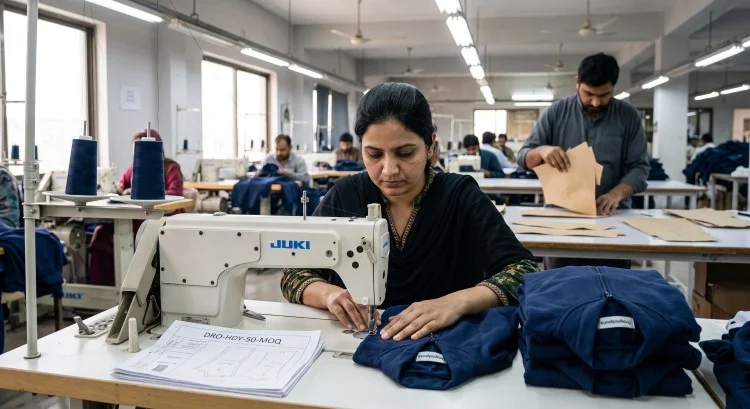
How Low MOQ Manufacturing Differs From Industrial Apparel Mills
Industrial apparel mills are generally structured around large production runs. Their systems are designed to maximize efficiency when producing substantial quantities of the same garment.
For smaller brands, those requirements can create excessive inventory and capital commitments. Specialized small batch clothing manufacturers instead provide production options that are more suitable for startups, boutique labels, capsule collections, and brands testing new products.
A professional low moq apparel manufacturer can still provide technical product development, custom patterns, fabric selection, branding, and quality inspection. The primary difference is the scale of the production run.
Why Flexible Quantities Matter for Emerging Clothing Labels
Flexible quantities allow brands to test a product before committing to larger inventory. A brand can begin with a small production run, evaluate customer response, and then reorder the approved product in larger quantities.
This makes clothing manufacturers with low moq particularly useful for new brands that need to balance product development with inventory risk.
Cut-and-Sew Customization vs. Print-on-Demand Blanks
Print-on-demand commonly begins with an existing blank garment. While artwork can be customized, the original garment’s fit, fabric, construction, and measurements may remain fixed.
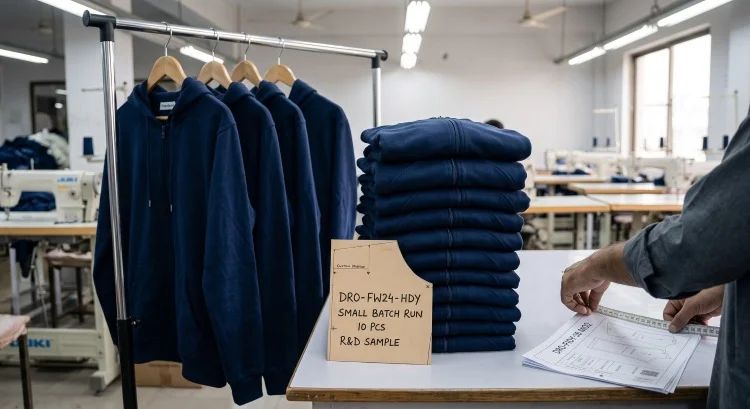
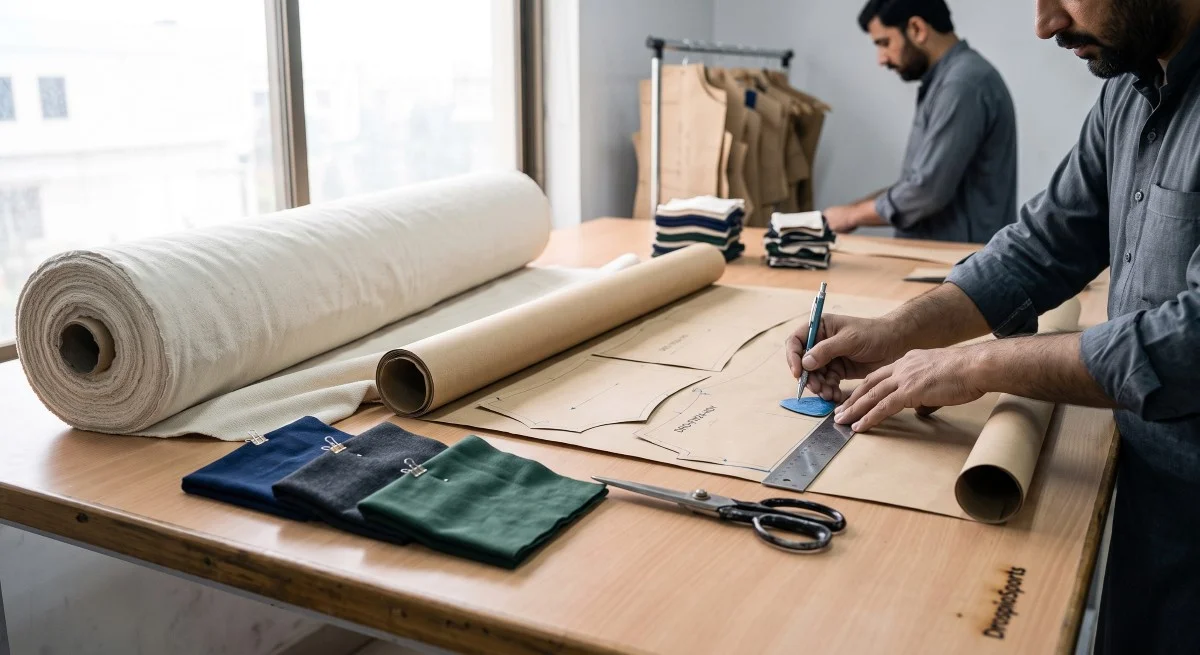
By contrast, small batch cut and sew manufacturers begin with fabric and develop the garment according to the buyer’s specifications. This provides greater control over silhouette, measurements, GSM, stitching, branding, and finishing.
Low MOQ Clothing Production Starting From 20 Pieces
DrospioSports supports custom production starting from approximately 20 pieces per design, subject to the garment, fabric, colorway, and customization requirements. This model allows small batch apparel manufacturing to remain accessible to emerging brands while retaining a professional product-development process.
| Order Size | Ideal Application | Fabric Sourcing Model | Customization Scope | Per-Unit Cost Dynamics | Sample Rebate Status |
|---|---|---|---|---|---|
20 pieces |
Product testing / capsule launch |
Available or approved running fabrics |
Full custom development subject to requirements |
Highest per-unit setup impact |
Confirmed per quotation |
50 pieces |
Small collection / initial commercial run |
Available fabrics or selected sourcing |
Custom cut-and-sew, branding and finishing |
Lower setup impact than 20 pieces |
Confirmed per quotation |
200+ pieces |
Repeat production / scaling |
Broader sourcing flexibility |
Full production customization |
Greater production efficiency |
Confirmed per quotation |
How 20-Piece and 50-Piece Production Runs Work
For buyers comparing clothing manufacturers with 20 pcs moq, the production process still involves technical preparation, fabric allocation, cutting, sewing, decoration, finishing, and inspection.
A 50-piece order can provide additional flexibility for size distribution and colorways. Brands researching clothing manufacturers with 50 pcs moq can use this quantity for an initial collection while keeping inventory more controlled than a conventional high-volume order.
The final quotation depends on garment construction, fabric, GSM, artwork, decoration, labels, packaging, and quantity.
Sizing Breakdowns and Colorway Distribution for Small Batches
Buyers should provide their preferred size breakdown and color distribution when requesting a quotation. A 20-piece order may concentrate quantities around core sizes, while a 50-piece collection can provide more flexibility across sizes or colors.
Early confirmation of the size curve and colorway helps the factory plan fabric consumption, cutting, and production requirements accurately.
Who We Serve: Flexible Apparel Manufacturing for Global Buyers
Our production model supports international buyers looking for small batch clothing manufacturers that can work with custom product specifications.
Independent Clothing Brands & First-Time Founders
Startups often need a manufacturing partner that can turn a concept into a physical garment without requiring a large first order. Clothing manufacturers for startups should be able to review technical information, identify missing specifications, and develop samples before production.
Our process supports founders working with tech packs, sketches, reference garments, artwork, and measurement charts.
Direct-to-Consumer (DTC) & Boutique Fashion Labels
DTC and boutique brands can use small batch clothing manufacturing for limited collections, seasonal launches, controlled inventory, and product testing.
A smaller first production run can provide customer feedback before the brand commits to larger quantities.
Fitness, Gym Wear & Performance Activewear Brands
Fitness and activewear businesses may require T-shirts, shorts, leggings, sports tops, tracksuits, and other performance garments.
Fabric selection can include cotton, polyester, spandex, and blended materials depending on the required stretch, recovery, comfort, weight, and intended use.
Established Labels Testing Seasonal Capsule Lines
Established brands can also benefit from small batch clothing manufacturing when testing a new silhouette, seasonal color, limited edition, or capsule collection.
Once a product is validated, the approved specifications can be retained for larger repeat orders.
Custom Cut-and-Sew Development: From Tech Pack to Physical Pattern
Professional small batch cut and sew manufacturers should provide a controlled path from design specification to production. DrospioSports develops garments using technical information that can be reviewed, sampled, revised, and approved before bulk manufacturing.
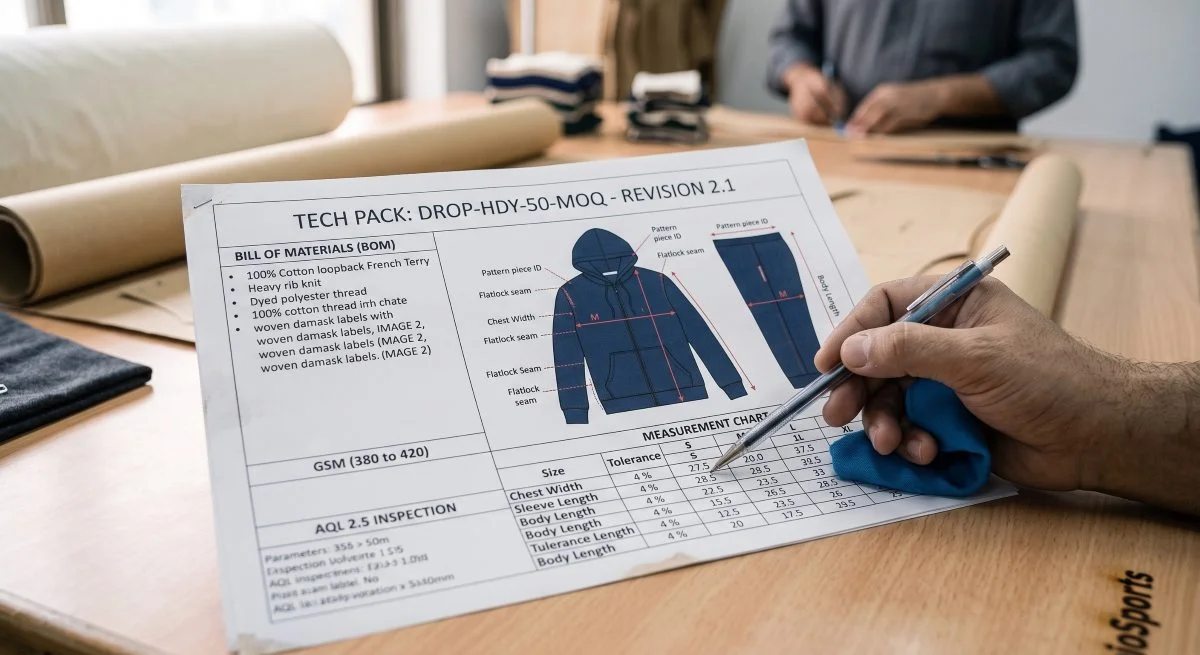
Tech Pack, Bill of Materials (BOM), and Measurement Chart Review
A tech pack can contain garment measurements, fabric composition, GSM, colors, trims, artwork placement, construction details, labels, and packaging specifications.
The Bill of Materials identifies the components required for production, while the measurement chart establishes finished garment dimensions.
This technical review helps clothing manufacturers for startups understand the exact product requirements before sampling begins.
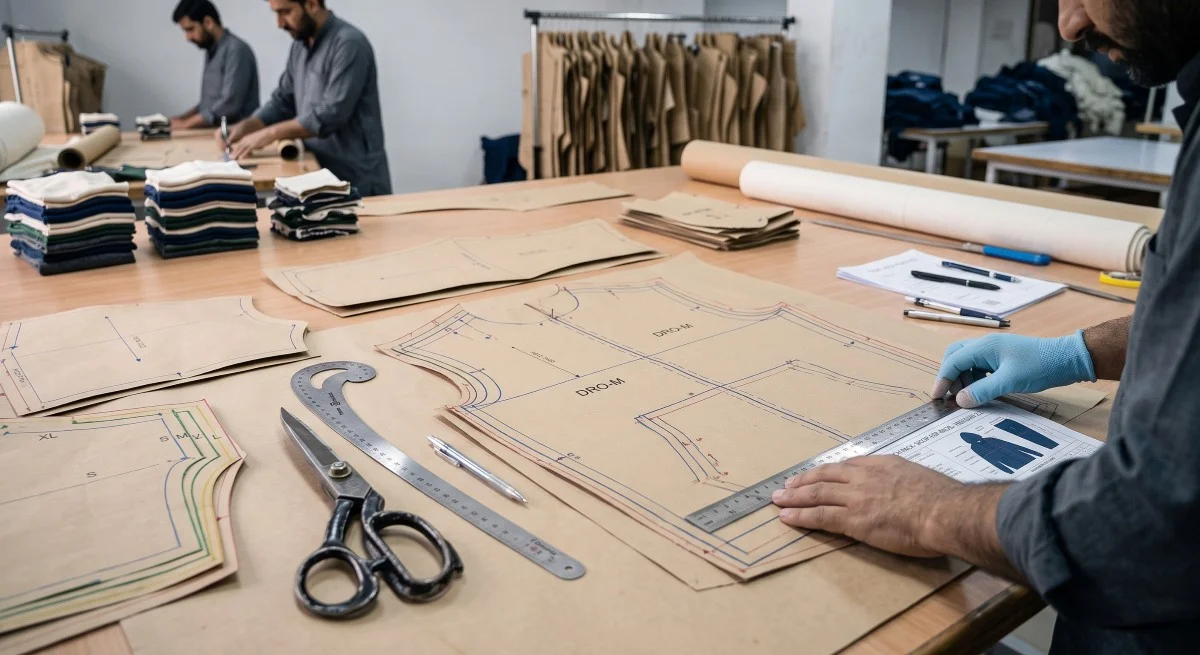
Pattern Drafting, Fit Development, and Sizing Grading
Pattern drafting converts garment specifications into physical pattern pieces. Fit development considers silhouette, fabric behavior, construction, and the intended size range.
Sizing grading then creates additional sizes while maintaining appropriate proportions.
Finished measurements can be checked against the approved specifications, with production tolerances maintained within approximately ±0.5 cm to 1.0 cm, depending on the garment area and agreed specification.
Manufacturing Solutions Across Streetwear, Sportswear, and Casualwear
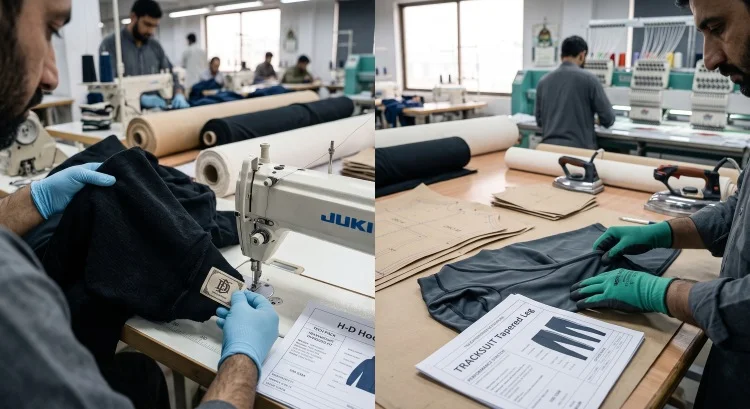
The same product-development workflow can support streetwear, casualwear, activewear, and sports garments.
Streetwear may require oversized silhouettes and heavyweight fabrics, while sportswear may require stretch fabrics and performance-focused construction.
For buyers developing matching athletic garments, explore our custom tracksuits from 20 pieces manufacturing framework.
Low MOQ Streetwear and Capsule Collection Manufacturing
Streetwear production requires careful control over silhouette, fabric weight, construction, and branding. A dedicated low moq custom clothing manufacturer can help brands develop smaller capsule collections without committing to large inventory quantities.
Small-Batch Streetwear: Heavyweight Fabrics, Drop-Shoulders & Custom Cuts
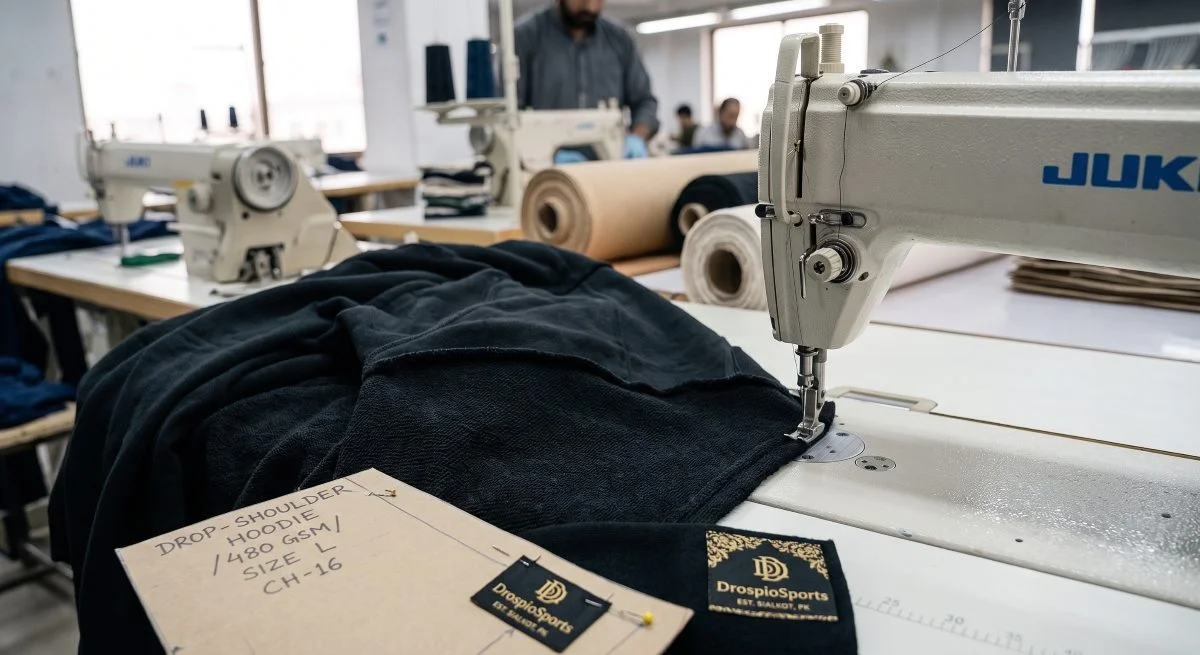
Oversized garments require accurate pattern proportions because body width, shoulder placement, sleeve dimensions, cuffs, and body length affect the final silhouette.
Heavyweight fleece and French Terry can be used when the desired product requires greater structure and weight.
For hoodie collections, explore our custom cut-and-sew hoodies production options.
High-Density Decoration: 3D Puff Print, Screen Printing, DTF & Embroidery
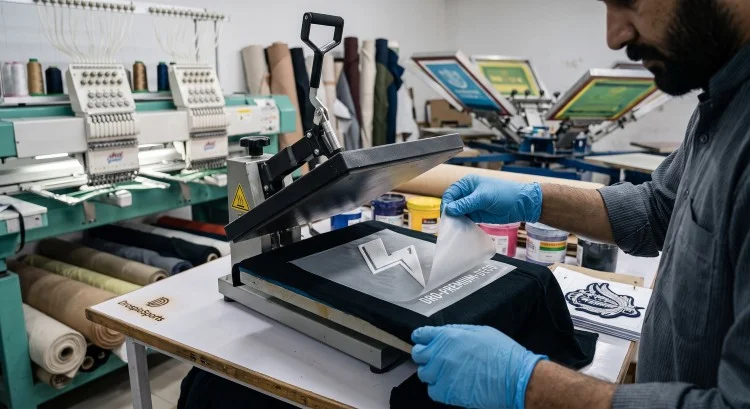
Decoration options can include screen printing, DTF, 3D puff effects, embroidery, and sublimation.
The appropriate method depends on artwork complexity, fabric composition, garment construction, production quantity, and desired appearance.
For smaller orders, decoration selection should be considered during quotation because setup requirements can influence the total production cost.
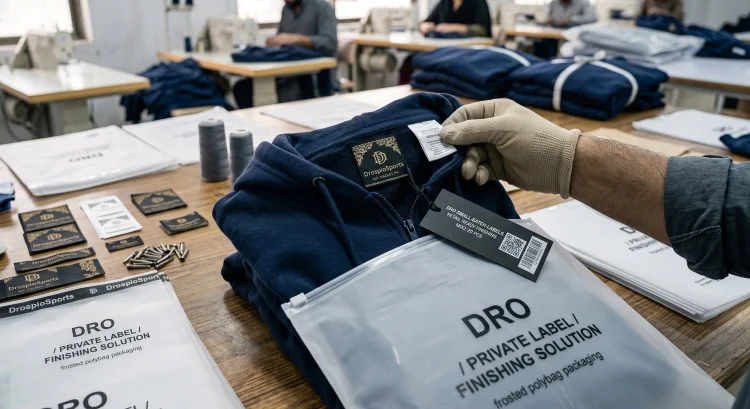
Complete Private Label Finishing: Woven Damask Tags, Hangtags & Frosted Packaging
Private-label finishing can include woven damask labels, care labels, hangtags, branded packaging, and other presentation components.
These finishing options allow brands to develop a complete branded product rather than simply applying a logo to an existing blank.
Explore our complete private label finishing capabilities for broader branding requirements.
Premium Fabric and GSM Selection for Low MOQ Orders
Fabric selection affects garment weight, hand feel, drape, durability, comfort, appearance, and cost. For small moq clothing manufacturers, fabric availability can also influence how efficiently a small production run can be completed.
Choosing the Right Textile and GSM (180 GSM Single Jersey to 500 GSM Fleece)
Common fabric categories include:
• 180 GSM single jersey: For lightweight T-shirts.
• 240–280 GSM cotton and jersey: For heavier casual tops and premium streetwear tees.
• 280–350 GSM French Terry: For sweatshirts and transitional garments.
• 400–500 GSM brushed fleece: For heavyweight luxury streetwear hoodies.
• Polyester and spandex blends: For selected performance and activewear garments.
Brands searching for an agile low moq t shirt manufacturer should consider GSM together with fabric composition, fit, intended climate, wash performance, and desired hand feel.
For performance-focused apparel, explore our OEM sportswear manufacturing service.
Available Knits vs. Custom Vat Dyeing: How Small Fabric Runs Work
Available stock fabrics are generally more practical for very small orders because custom dyeing can require additional material quantities and setup.
When a buyer requires a specific shade, fabric availability and dyeing requirements should be confirmed before production.
For clothing manufacturers low moq sourcing, using suitable available fabrics can simplify material planning for initial small production runs.
Shrinkage Control, Fabric Pre-Washing & Colorfastness Standards
Depending on the fabric, pre-washing, compacting, or heat-setting processes may be used to manage dimensional stability.
Where applicable, pre-shrunk and compacted knit fabrics can be controlled toward a residual dimensional change target of approximately under 3%–5%, subject to fabric composition and agreed testing conditions.
End-to-End Low MOQ Production Process: Step-by-Step
The DrospioSports workflow moves from technical specifications through sampling, approved production, inspection, and export.
| Stage Number | Production Phase | Factory Execution | Buyer Action/Milestone | Estimated Lead Time |
|---|---|---|---|---|
Stage 1 |
Technical Review & Fabric Sourcing |
Review specifications, fabrics, measurements and artwork |
Confirm product requirements |
Initial review (1–3 days) |
Stage 2 |
PPS & Fit Development |
Develop sample and review construction |
Approve or request revisions |
Approximately 7–10 days |
Stage 3 |
Bulk Cut-and-Sew |
Cutting, sewing, decoration and finishing |
Confirm production approval |
Approximately 20–30 days |
Stage 4 |
Quality Inspection |
Measurement, construction and AQL checks |
Confirm agreed quality requirements |
During / following production |
Stage 5 |
Packing & Export |
Final packing and international dispatch |
Confirm shipping details |
Transit commonly 4–6 business days |
Step 1: Technical Spec Review and Fabric Sourcing
The process begins with a tech pack, sketch, artwork, reference sample, measurement chart, or product concept.
Fabric composition, GSM, colors, trims, decoration, labels, and packaging requirements are reviewed before production planning.
Step 2: Pre-Production Sampling (PPS) and Fit Revisions
A Pre-Production Sample establishes a physical reference for fabric, fit, measurements, construction, branding, and finishing.
For buyers comparing clothing samples manufacturers, the sample stage is an important opportunity to identify fit or construction changes before bulk production.
As experienced clothing prototype manufacturers, we can also work from early product concepts and available technical references. Sample requirements and applicable sample fees are confirmed during quotation; where a sample credit applies, the terms should be confirmed before the bulk order.
Step 3: Precision Bulk Cut-and-Sew Assembly
After sample approval, the approved pattern and cutting markers are prepared. Fabric is cut according to the production specifications and assembled through sewing operations.
Production can use approximately 10–12 stitches per inch (SPI) with 4-thread overlock and twin-needle coverstitching where appropriate to the garment construction.
Step 4: Multi-Stage Quality Control and AQL 2.5 Inspection
Quality inspection can cover measurements, seams, stitching, loose threads, construction, decoration placement, and finishing.
Measurement checks are maintained against the approved specifications, with the agreed tolerance range applied to the relevant garment areas.
Before final export packing, standardized AQL 2.5 random sampling can be applied for quality auditing.
Step 5: Export Packaging and Express Worldwide Air Delivery
Finished garments are folded, packed, placed into export cartons, and prepared according to the agreed shipping arrangement.
For international priority air delivery from Sialkot, typical door-to-door transit can be approximately 4–6 business days via DHL Express or FedEx International Priority, depending on destination, customs processing, and service availability.
Small-Batch Pricing Dynamics and Scaling Into Bulk Production
The economics of low moq clothing manufacturing differ from large-volume production because development and setup costs are distributed across fewer garments.
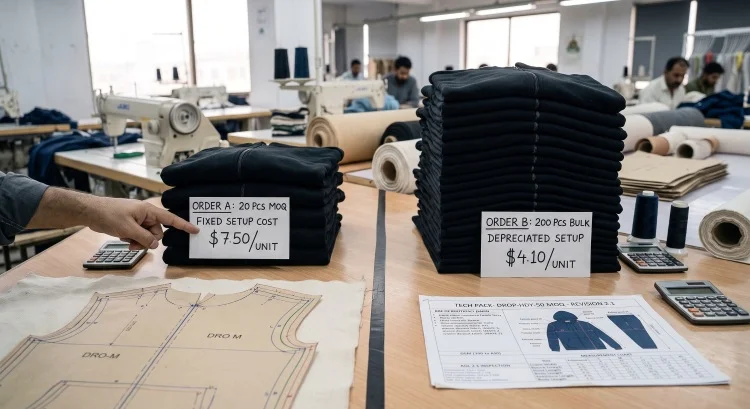
Understanding Unit Economics and Setup Costs on Low Quantities
Pattern preparation, cutting setup, fabric allocation, decoration setup, sampling, and production handling can create costs regardless of quantity.
This is why buyers comparing affordable clothing manufacturers for startups should consider the complete manufacturing process rather than comparing the unit price alone.
A 20-piece order will normally have a different per-unit cost structure from a 200-piece order because fixed preparation costs are distributed across different quantities.
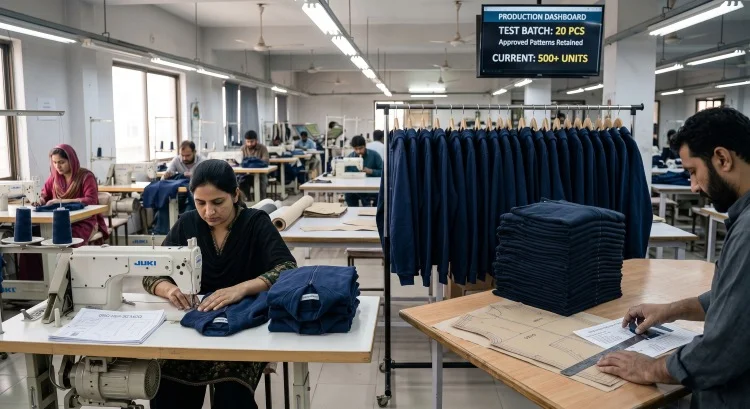
How to Scale From a 20-Piece Test Batch to 500+ Unit Production
The purpose of low MOQ production is not necessarily to keep every order small. It provides a practical starting point for testing products.
Approved patterns, measurements, artwork, fabric details, construction specifications, and packaging requirements can be retained for future production.
This allows a small batch clothing manufacturer relationship to develop into larger repeat production when demand increases.
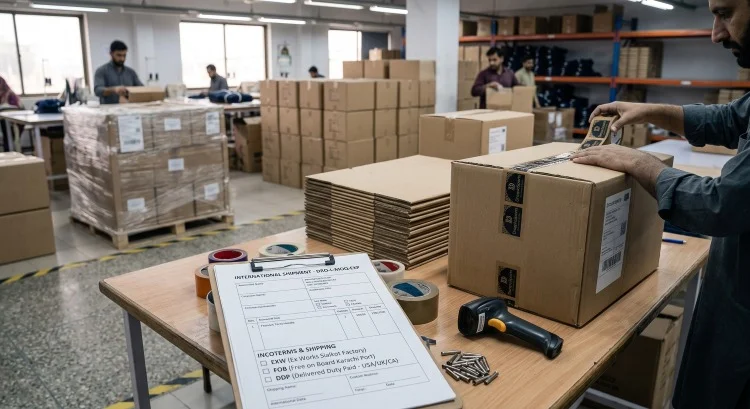
International B2B Payment Terms and Global Shipping Options (EXW, FOB, DDP)
International buyers may use commercial terms such as EXW, FOB, or DDP depending on the agreed transaction structure.
The responsibilities for transportation, export procedures, import handling, duties, and final delivery vary between terms. The exact payment and shipping conditions should therefore be confirmed in the quotation before production.
DrospioSports vs. Standard Apparel Factories and Broker Networks
When evaluating clothing manufacturers with low moq, buyers should consider more than minimum quantity. Communication, customization, technical development, production control, and scalability also affect the sourcing relationship.
| Comparison Feature | DrospioSports Direct Factory | Domestic Print Studios | Sourcing Broker Platforms |
|---|---|---|---|
Small MOQ |
Custom production from approximately 20 pieces |
Often focused on existing blanks |
Supplier dependent (often 100–300 pcs) |
Custom Cut-and-Sew |
Available on all orders |
Usually limited |
Supplier dependent |
Product Development |
Tech packs, patterns and sampling |
Generally limited |
Varies widely |
Direct Factory Communication |
Yes (direct with merchandisers) |
Yes |
Often mediated by third parties |
Branding & Finishing |
Labels, printing, embroidery and packaging |
Mainly decoration only |
Supplier dependent |
Scaling Potential |
Small batch to larger production |
Usually limited for full manufacturing |
Supplier dependent |
Production Comparison: Direct Factory vs. Aggregator Platforms
Aggregator platforms can provide access to multiple suppliers, but communication may involve intermediaries.
Direct factory sourcing allows technical specifications, sample revisions, fabric requirements, and production questions to be discussed directly with the manufacturing side.
For brands searching for a clothing manufacturer with low moq, this can be particularly relevant when the product requires custom construction rather than simple decoration.
When Low MOQ Manufacturing Delivers the Highest Return on Capital
Small production quantities can be useful when a brand wants to validate a product before purchasing substantial inventory.
A controlled initial run can provide market feedback and identify which designs should receive larger production investments.
This approach is particularly relevant for small moq clothing manufacturers serving startups and brands testing new collections.
Frequently Asked Questions About Low MOQ Clothing Manufacturing
What is considered a low MOQ in custom clothing manufacturing?
A low MOQ generally means a manufacturer accepts quantities below the minimums commonly required by high-volume factories. The exact threshold depends on the garment, fabric, customization, and production method. DrospioSports supports custom production from approximately 20 pieces per style, making the service suitable for startups, capsule collections, testing, and smaller commercial production.
Can I order 20 pieces from a clothing manufacturer?
Yes. DrospioSports can support custom apparel production starting from approximately 20 pieces per style, subject to product requirements. Buyers should provide the garment type, fabric, GSM, size breakdown, colorway, artwork, branding, and packaging requirements so the production specifications and quotation can be evaluated accurately.
Can clothing manufacturers accept 50 pieces per design?
Yes. A 50-piece order can provide greater flexibility for size distribution and color allocation while remaining suitable for smaller brands. Working with clothing manufacturers with 50 pcs moq can be useful for first collections, capsule launches, seasonal products, and product testing before larger repeat orders are considered.
Is low MOQ clothing manufacturing suitable for startups?
Yes. Partnering with dedicated clothing manufacturers for startups can provide a practical route for turning a product concept into physical inventory without requiring a large initial commitment. Our low moq clothing manufacturing allows a startup to test designs, evaluate customer response, and use approved specifications for future production.
Can I get a physical sample before placing a bulk clothing order?
Yes. A Pre-Production Sample can be developed before bulk manufacturing so the buyer can review fabric, fit, measurements, construction, branding, and finishing. Buyers evaluating clothing samples manufacturers should confirm sample requirements, timing, fees, revisions, and any applicable sample-credit policy before proceeding with bulk production.
Can I customize fabrics, labels, printing, and packaging with a low MOQ?
Yes. An agile low moq custom clothing manufacturer can support customization across fabric selection, GSM, printing, embroidery, woven labels, care labels, hangtags, and packaging, subject to the specific production requirements. Decoration can include screen printing, DTF, puff effects, sublimation, and embroidery.
Can a small-batch clothing order be scaled into larger production?
Yes. A successful initial order can establish the approved technical specifications for future manufacturing. Patterns, measurements, artwork, construction details, fabric information, and packaging requirements can be retained so the product can move from a small batch clothing manufacturer order toward larger quantities.
What information do I need to request a manufacturing quote?
Provide the garment type, target quantity, size breakdown, colors, fabric composition, GSM, artwork, branding requirements, packaging requirements, and delivery target. A tech pack, reference sample, sketch, or measurement chart can improve quotation accuracy and help clothing manufacturers low moq understand the complete production requirement.
Launch Your Custom Small-Batch Apparel Production
Transform your apparel concept into finished retail garments with custom cut-and-sew manufacturing tailored for flexible order volumes. Our engineering team reviews your tech pack, validates fabric choices and GSM, coordinates rapid sampling, and delivers a transparent small-batch manufacturing quotation.
Factory-direct production starting from 20 pieces per style
Custom pattern grading, private labeling, and branded packaging
7–10 day pre-production sample evaluation and fit approval
Direct merchandiser communication throughout the manufacturing cycle
info@drospiosports.com | Instant direct factory support
Fill in your project details
It only takes a minute. Fields marked with * are required.
Start Your Low MOQ Clothing Manufacturing Project with DrospioSports
When comparing clothing manufacturers low moq options for a new drop or capsule launch, prepare four core specifications: your tech pack (measurements and artwork), quantity with size breakdowns, target fabric GSM, and required deadlines.
DrospioSports provides an end-to-end pathway as a direct low moq apparel manufacturer, handling custom development, sampling, cut-and-sew assembly, branding, and export. Whether you need affordable clothing manufacturers for startups or are vetting flexible small batch clothing manufacturers, we enable controlled production that scales seamlessly. To partner with an agile low moq clothing manufacturer for your next project, finalize your specs and submit your tech pack for quotation.
